
 Alice Leroy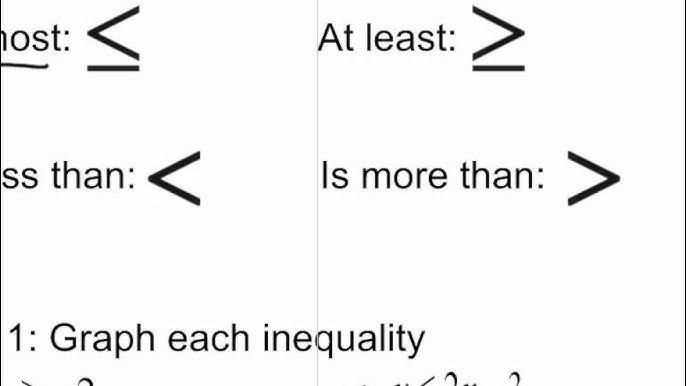
The “at least” inequality sign denotes a crucial concept in mathematics that often leads to confusion. Understanding how to interpret this symbol correctly is paramount in solving mathematical expressions accurately. Many students and even some adults grapple with the subtleties of the “at least” inequality sign, but fear not – clarity is within reach. Let’s delve into this perplexing symbol, unpack its significance, and equip you with the tools to navigate its complexities effortlessly. Let’s demystify the enigmatic nature of the “at least” inequality sign together.

The At Least Inequality Sign: Understanding Its Meaning and Uses
Introduction to the At Least Inequality Sign
Hey there! Have you ever come across a symbol that looks like an equal sign with a little extra? That’s the at least inequality sign! It’s a funky-looking symbol that tells us about relationships between numbers. In this article, we’re going to dive deep into the world of at least inequality sign to discover what it means and how we can use it in our everyday math adventures.
What Does the At Least Inequality Sign Look Like?
Picture an equal sign (=) with a little more. That’s right, the at least inequality sign has an extra line on top of the equal sign, making it look like this: ≥. This symbol might seem strange at first, but once we understand its meaning, we’ll see how powerful it can be in solving math problems.
Understanding the Meaning of the At Least Inequality Sign
Now, let’s get to the heart of the matter. When we see the at least inequality sign (≥) between two numbers, it tells us that the number on the left is greater than or equal to the number on the right. In simpler terms, it means the first number is as big as or bigger than the second number.
For example, if we have 5 ≥ 3, it tells us that 5 is greater than or equal to 3. In this case, 5 is indeed bigger than 3, so the statement is true.
Examples and Applications
Let’s look at some real-world examples of how we can use the at least inequality sign:
Example 1: Comparing Ages
Imagine you have three friends: Sarah, John, and Emily. Sarah is 10 years old, John is 9 years old, and Emily is 10 years old. If we write their ages using the at least inequality sign, it would look like this:
Sarah’s age: 10 ≥ 9 (true)
Sarah’s age: 10 ≥ 10 (true)
John’s age: 9 ≥ 10 (false)
Based on these comparisons, we can see that Sarah is at least as old as John and older than Emily.
Example 2: Daily Step Goal
Let’s say you want to walk at least 5000 steps every day to stay healthy. You could represent this goal using the at least inequality sign:
Daily steps walked: x ≥ 5000
This means that as long as you walk 5000 steps or more, you are meeting your goal. If you walk exactly 5000 steps, that’s great too!
Practical Tips for Using the At Least Inequality Sign
Now that we know what the at least inequality sign means, let’s explore some practical tips for using it effectively:
Tip 1: Pay Attention to the Direction
Remember that the open end of the at least inequality sign always points towards the larger number. This helps us quickly identify which number is greater when comparing values.
Tip 2: Think About Inclusivity
Since the at least inequality sign includes the possibility of equality, it’s important to consider both scenarios when working with this symbol. Make sure to account for when the numbers can be equal in your calculations.
Tip 3: Practice, Practice, Practice
The more you practice using the at least inequality sign, the more comfortable and confident you’ll become in handling comparisons between numbers. Look for opportunities to apply this symbol in various math problems to strengthen your skills.
In conclusion, the at least inequality sign (≥) is a handy tool for comparing numbers and expressing relationships in mathematics. By understanding its meaning and practicing its use, we can become more adept at analyzing numerical values and making informed decisions based on comparisons. So, the next time you encounter the at least inequality sign, remember that it’s all about showing us when one number is greater than or equal to another. Happy math adventures!
✅✅Symbols of Inequality #Inequalities #math #algebra
Frequently Asked Questions
What are the different types of inequality signs used in mathematics?
In mathematics, there are primarily two inequality signs: the greater than sign (>), which denotes that one value is larger than another, and the less than sign (<), which indicates that one value is smaller than another. Additionally, there are the greater than or equal to sign (≥) and the less than or equal to sign (≤) which include the possibility of values being equal.
How do you read and interpret the “at least” inequality sign in mathematics?
The phrase “at least” in mathematics often corresponds to the greater than or equal to sign (≥). When you encounter “x is at least 5,” it means that x can be equal to 5 or any value greater than 5. In other words, x can be 5 or any number larger than 5.
Can the “at least” inequality sign be represented in mathematical expressions?
Yes, the “at least” concept can be represented in mathematical expressions using the greater than or equal to sign (≥). For example, if you have an equation x ≥ 8, it signifies that x is equal to 8 or any number greater than 8. This representation allows for clarity in indicating a range of possible values.
Final Thoughts
In conclusion, striving for equality in all aspects of society is paramount. To combat systemic discrimination, we must take proactive measures to bridge the gap between privilege and disadvantage. It is crucial to address the root causes of inequality and advocate for policies that promote fairness and justice. We must work together to create a world where everyone has equal opportunities and rights, and where the inequality sign is more a symbol of progress than of division.